China’s ChangXin Memory Technologies, CXMT, has turned into the fourth force in DRAM at the worst possible moment for the incumbents: researchers at Counterpoint put its market share at 9 percent in the third quarter of 2026, the company’s own filings point to a swing into massive profit, and the man often called the godfather of Taiwan’s DRAM industry says CXMT could flood the market within two years. All of this lands while DRAM contract prices are still climbing double digits, quarter after quarter, because the AI buildout is eating every HBM stack the big three can make.
What happened: the ten-fab plan and the DRAM price curve
The week’s news came from Charles Kau, the veteran Taiwanese DRAM executive known as the “godfather of DRAM,” who said CXMT is building up to ten more fabs and could flood the market with memory by 2028. TechNews reported his remarks, TrendForce and other outlets picked them up, and he added that memory manufacturing and foundry processes are fundamentally different, so TSMC will not enter conventional DRAM production to compete.
The financial backdrop makes his warning credible rather than rhetorical. CXMT’s stock-exchange filing, as reported by China Daily Star, points to profit of up to 132.5 billion yuan for the first nine months of 2026, reversing a loss a year earlier, as AI demand tightened DRAM supply and lifted prices, with revenue projected to rise more than eightfold. DIGITIMES reported that CXMT’s prepayments surged sixteenfold as it locks in materials and capacity for expansion, and that mainstream DRAM supply is tightening precisely because Samsung, SK hynix and Micron are prioritizing HBM and advanced DRAM. Counterpoint’s quarterly figures, as reported, show CXMT’s share rising to 9 percent while Samsung led with 38 percent and SK hynix grew revenue more than 40 percent quarter over quarter.
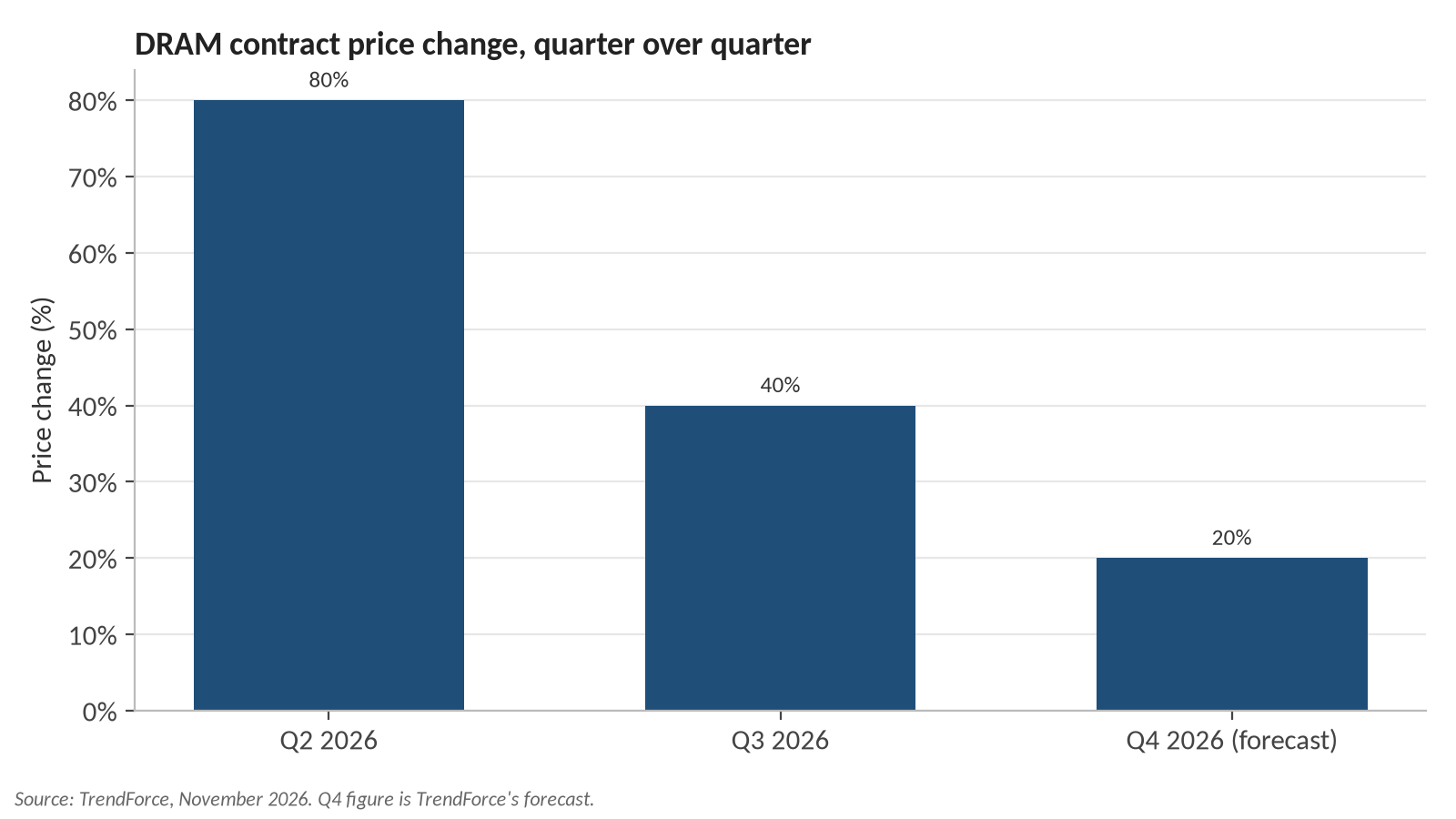
Prices tell the rest of the story. TrendForce expects fourth-quarter DRAM contract prices to rise about 20 percent quarter over quarter, on top of roughly 80 percent in the second quarter and 40 percent in the third, with average selling prices around 1.9 dollars per gigabit by late in the year. Buyers of ordinary DDR5 are paying AI-boom prices for commodity memory.
Who is CXMT, and why its 9 percent DRAM share matters
CXMT’s rise is a story about what happens when the top of the market pulls every advanced fab upward and leaves the floor open. The big three are converting capacity to HBM because HBM margins are extraordinary, which drains supply from mainstream DRAM and pushes its price up. CXMT sells into exactly that hole: its fabs run mature DRAM nodes, its customers are largely domestic Chinese module and device makers, and its cost position improves every quarter the incumbents leave commodity DRAM undersupplied. A 9 percent share does not sound like much until you remember that DRAM pricing is set at the margin, and a new entrant adding capacity into a tight market is adding it at the margin.
The ten-fab expansion Kau describes is the part to watch, because its throttle is not money or demand. It is equipment. CXMT’s ability to build and outfit fabs at that pace depends on what deposition, etch and inspection tools it can actually buy, and that is governed by the export control regime this site covers Thursday. A fab shell goes up in months; a fab full of advanced tools does not, when the toolmakers need licenses they may not get. The godfather’s two-year flood scenario and the tool ban are the same story told from two ends: one describes the demand for equipment, the other describes the supply.
For buyers, the near-term read is unchanged: memory stays expensive through 2027, because the HBM conversion is structural and CXMT’s added capacity, even if it materializes on schedule, is aimed at mainstream parts that still take years to qualify into servers and PCs. For the industry, the read is that DRAM has acquired the one thing its oligopoly never had in two decades: a fourth player with state backing, rising yields, and no exposure to the pricing discipline the big three try to maintain. Oligopolies end when someone outside them decides volume matters more than price. CXMT’s profit statement says that decision has been made.
FAQ
What is CXMT? ChangXin Memory Technologies, a Chinese DRAM manufacturer based in Hefei. It is the largest memory maker in China and, by Counterpoint’s third-quarter 2026 estimate, holds about 9 percent of the global DRAM market.
Why are DRAM prices rising in 2026? AI data-center demand for HBM has led Samsung, SK hynix and Micron to convert capacity away from conventional DRAM, tightening mainstream supply. TrendForce reported contract price increases of roughly 80 percent in the second quarter of 2026, 40 percent in the third, and about 20 percent expected in the fourth.
Will CXMT’s expansion crash DRAM prices? The “godfather of DRAM,” Charles Kau, said in November 2026 that CXMT could flood the market within two years by building up to ten more fabs. Whether that happens depends heavily on export controls, which limit the advanced equipment CXMT can buy. Near term, its capacity targets mainstream DRAM, not HBM.
Does CXMT make HBM? CXMT has been reported to be developing HBM-class packaging for the domestic Chinese market, but its volume business is conventional DDR4 and DDR5 DRAM, and the incumbents’ HBM lead remains several years deep.