ASML’s EUV machines are sold out through 2028
ASML told investors on October 14 that its planned supply of EUV lithography systems will not meet customer demand in 2027 and 2028, and buyers are now placing orders that stretch into 2029 and 2030, according to Yahoo Finance reporting on November 6. If you fab advanced chips, the machine that prints your layers is no longer something you buy, it is something you wait for.
That sentence sounds abstract until you remember what an EUV tool actually is. It is the single most complex production machine ever built, it costs more than most fabs’ entire metrology fleet, and right now exactly one company on Earth makes it.
Why the machine is hard, in one paragraph
EUV lithography prints circuit patterns using light at 13.5 nanometers, a wavelength so short it is absorbed by literally everything, including air and glass. So the light is generated by firing a laser at tin droplets fifty thousand times a second, and guided by mirrors polished to sub-atomic smoothness, in a vacuum. The workhorse Low-NA systems (numerical aperture 0.33) resolve features around 13 nm; the newer High-NA systems (0.55) resolve about 8 nm, as Inside Deep Tech’s 2026 guide to ASML’s machines explains. Every advanced logic node and, increasingly, every advanced DRAM node depends on these tools.
What the data shows
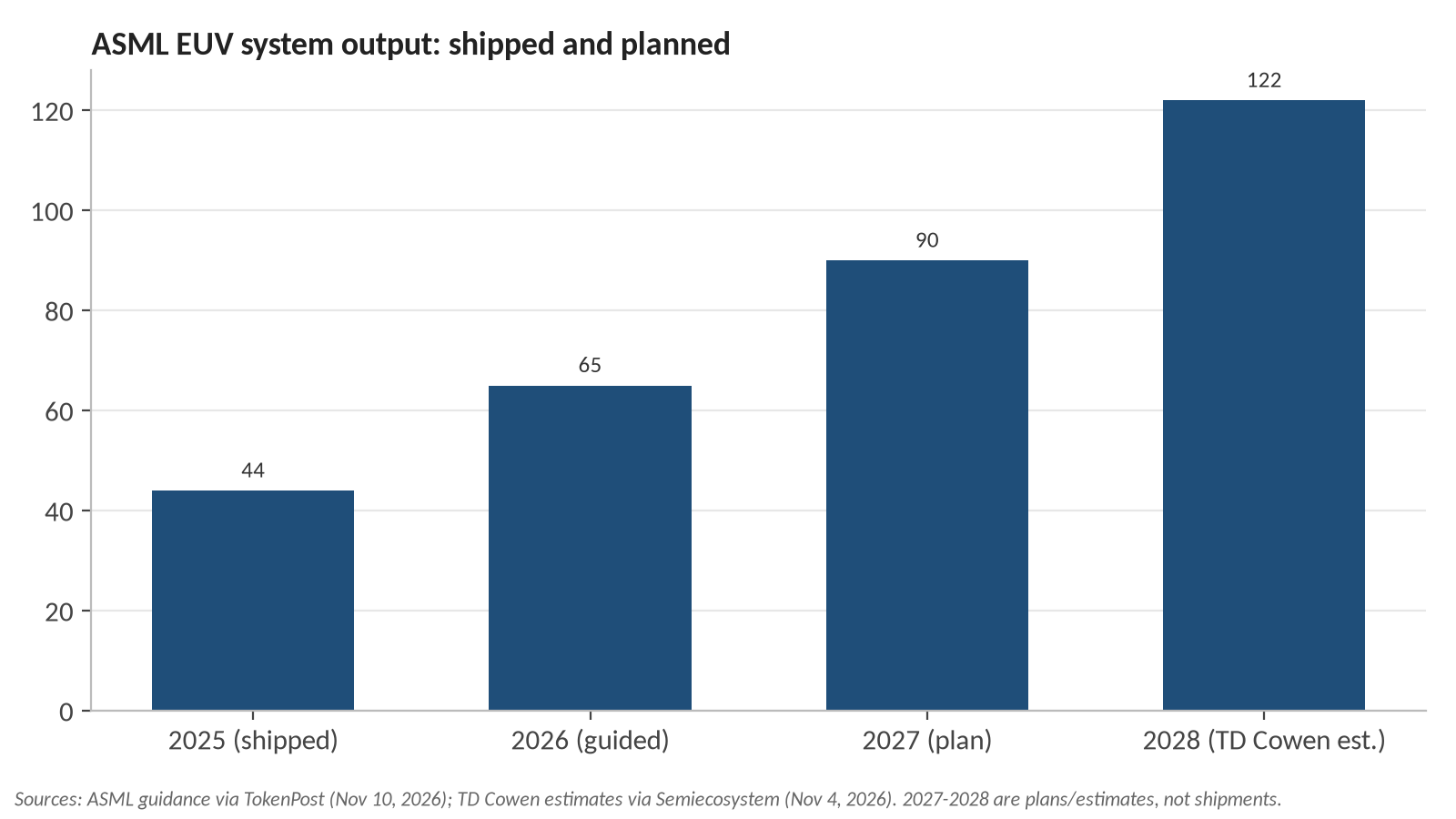
The numbers behind the shortage are stark. ASML expects to ship roughly 65 EUV systems in 2026, up from 44 in 2025, per TokenPost’s summary of the company’s guidance. The company plans to raise EUV capacity by about 30% in 2027 and is evaluating a further 30% rise for 2028, and even with those additions it expects supply to stay below demand. Analysts at TD Cowen, cited by Semiecosystem’s Mark Lapedus, model that as output climbing from roughly 90 systems in 2027 to 122 in 2028, and the order book still runs ahead of it.
Who is buying? Everyone, it turns out. DIGITIMES reported on November 9 that Samsung and SK hynix are racing to secure EUV tools because ASML has warned its planned capacity will fall short through 2028, with advanced DRAM expansion the driver. On November 20, Data Center Dynamics reported that Taiwanese DRAM makers Nanya and Winbond are also buying EUV tools, with Nanya expecting delivery next year and Winbond facing roughly a two-year wait. On the logic side, Inside Deep Tech’s guide reports that ASML said on July 15 that Intel Foundry is using High-NA EUV in high-volume manufacturing on selected layers of Intel 18A, and that the company said in September more than one million wafers have been processed across High-NA certification, R&D and production combined.
One more number worth watching: ASML guided China at about 20% of 2026 net sales, down from 33% in 2025, per The Innovation Attorney’s summary of the October 14 call. Domestic Chinese toolmakers are filling part of that gap with DUV-adjacent capability, but nothing in China prints EUV yet.
The fab floor read
From where the wafers run, this shortage is really a statement about DRAM. Memory makers resisted EUV longer than logic fabs because DRAM layers were coarse enough for immersion DUV with multi-patterning. That era is over: 1z-class and below DRAM needs EUV layers to keep cell size shrinking without stacking dozens of patterning passes, and HBM’s rise has made advanced DRAM the most profitable product in memory. So the same AI buildout that sold out HBM is now selling out the machines that make HBM possible. The fab floor consequence is lead time: a tool ordered today for a 2028 DRAM expansion is competing with TSMC’s and Intel’s logic roadmaps for the same shipping slots.
It also means lithography, not packaging or HBM alone, is a genuine constraint on accelerator supply. When a GPU maker says lead times are long, part of that chain traces back to a vacuum vessel in Veldhoven with a two-year queue.
What to watch next
Three things. First, whether ASML’s 2027 capacity expansion lands at the promised 30%, because that number sets the ceiling on 2028 DRAM bit growth. Second, High-NA adoption: Samsung, SK hynix and TSMC all plan to start using it in the coming years, per The Motley Fool’s November 12 recap, and each conversion changes the cost per layer math. Third, the November 23 session, where ASML stock jumped over 9% as the sector surged on Nvidia’s leadership news, a reminder that lithography trades as an AI proxy whether the fab floor likes it or not.
FAQ
How much does an ASML EUV machine cost?
Low-NA EUV systems run on the order of $150-200 million each, and High-NA systems are reported well above $300 million. ASML’s financial reports put average system prices in these ranges; the exact figure depends on configuration.
Why can’t other companies build EUV machines?
The supply chain is the moat: Zeiss builds the mirrors, Cymer (ASML-owned) the light sources, and decades of accumulated tolerances make replication a decade-scale project, as ITProGuides’ analysis of ASML’s monopoly notes.
Does DRAM really need EUV?
Below the 1z node, yes in practice. Samsung, SK hynix and now Nanya and Winbond are all adding EUV layers to advanced DRAM to control multi-patterning cost and defect density.
Sources: ASML Q3 2026 guidance as reported by TokenPost (Nov 10, 2026); DIGITIMES (Nov 9, 2026); Data Center Dynamics (Nov 20, 2026); Inside Deep Tech EUV guide (Nov 15, 2026); Yahoo Finance (Nov 6, 2026); The Motley Fool (Nov 12 and Nov 23, 2026).