The Nvidia AI bubble question, tested from the fab floor
Is the AI chip boom a bubble? The honest answer from the manufacturing layer is: the chips are real, the demand for them is real, and the financing wrapped around that demand is the part that should worry you. This week proved all three sentences at once.
On November 12, Nvidia CEO Jensen Huang resigned after revelations about personal conduct, and the company lost roughly $1.5 trillion in market value in a week, according to CNN’s November 23 report. On November 23, the board reinstated him unanimously after White House officials told President Trump there was no evidence of wrongdoing and Vice President Vance relayed that view to the board, as DigitalToday reported, and the Nasdaq closed up 6.5% for the session, with ASML up more than 9%, per Fortune and The Motley Fool’s market coverage. A single company’s governance crisis moving the entire semiconductor complex that violently is itself a data point about how concentrated the AI trade has become.
The bubble case, stated fairly
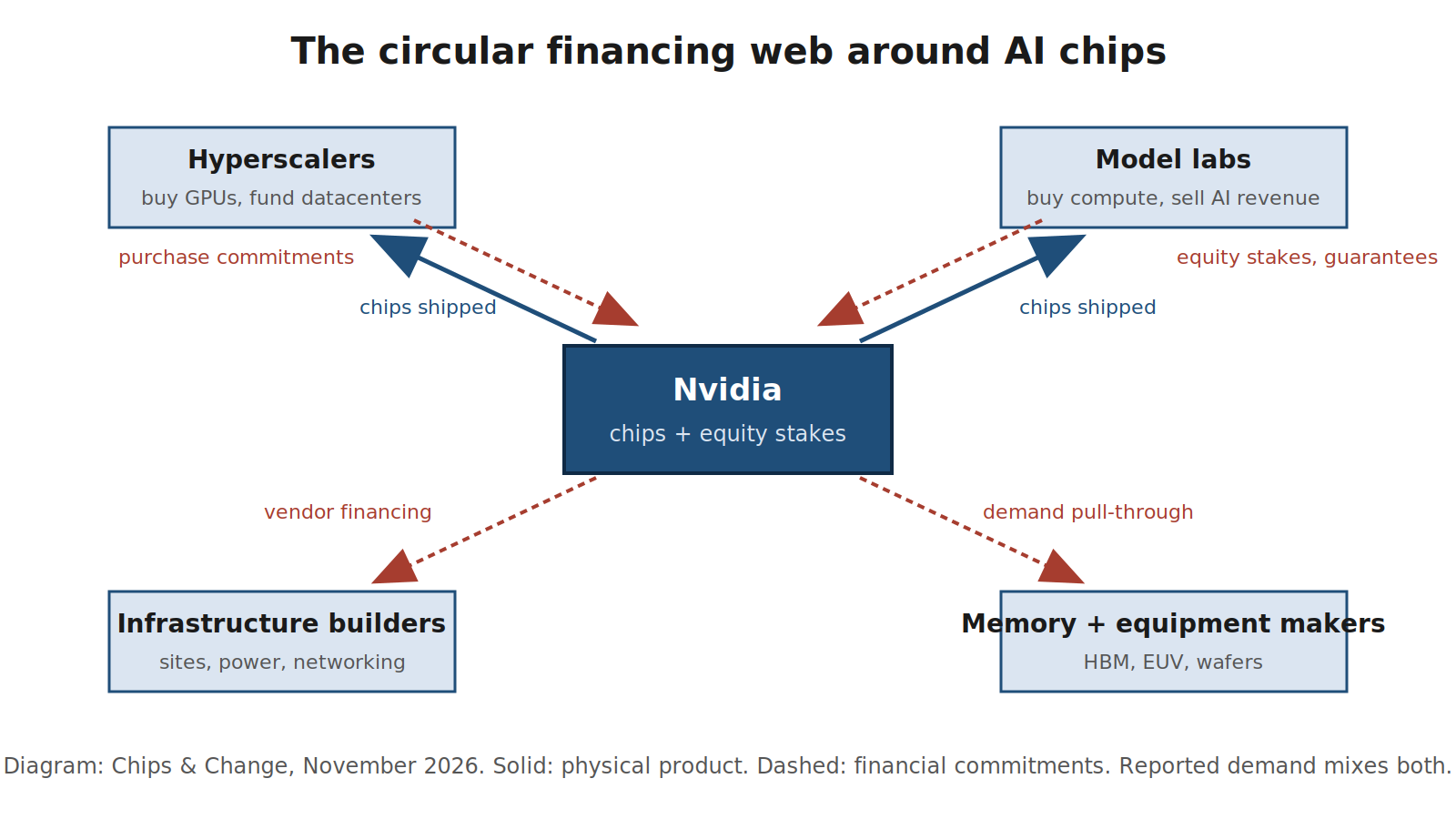
Skeptics are not claiming GPUs do not work. Axios, framing the week’s events on November 16, argued the technology can succeed and the investment around it can still be a bubble, which is exactly what happened in fiber optics in 2001: the internet was real, and the overbuilt capacity still wiped out its financiers. The specific worry is circularity. A web of equity stakes, purchase commitments and guarantees now connects Nvidia, the hyperscalers, the model labs and the infrastructure builders, with some analyses of the ecosystem, Emerald Book’s among them, citing figures on the order of $100 billion in equity stakes and $530 billion in guarantees. When the supplier funds its customers, who in turn buy the supplier’s chips, reported demand and organic demand are not the same number.
The fab floor test
Here is what the manufacturing layer can measure, independent of any investor deck. HBM supply is contractually sold out years forward, with SK hynix reporting on October 28 that DRAM and HBM volumes through 2029 are effectively committed, as FourWeekMBA and Finks reported from the earnings call. EUV lithography capacity is oversubscribed through 2028, per ASML’s October 14 guidance. Silicon wafer makers are raising prices with lead times stretching. Chips are physically being fabricated, packaged, shipped and installed in buildings with power contracts. In 2001, the fiber was also physically laid, which is the uncomfortable half of the analogy: real products can still be over-ordered.
The question the fab floor cannot answer is the one that matters for the bubble: what is the utilization of all those installed GPUs? Datacenter construction and chip shipments are observable; the revenue those GPUs generate for the companies that bought them is not publicly broken out with enough granularity to settle the argument. If AI application revenue grows into the installed base, the circular financing looks like aggressive but rational capacity building. If it does not, the same commitments become cancellation risk, and a memory industry that has sold out through 2029 discovers what its contracts’ termination clauses are worth.
What the governance episode changed
The week’s leadership scare, whatever its personal details, demonstrated a structural fact: the AI buildout has single-name risk. A $4-trillion-plus company whose founder said he built it so he alone could run it, as CNN reported, is a supply chain dependency for every hyperscaler, every HBM buyer and every equipment maker downstream. The market’s relief rally on his return was rational, but it priced in how little redundancy exists at the top of the stack.
What to watch next
Hyperscaler capital-expenditure guidance for 2027, which is the demand signal everything upstream is chained to. Nvidia’s next earnings report, the first clean read on whether the October quarter’s momentum survived the November turbulence. And memory pricing: if DRAM spot prices stall while the equity narrative wobbles, that divergence would tell you the physical demand and the financial narrative are decoupling.
FAQ
Is Nvidia a bubble?
A bubble requires prices detached from underlying value, and the underlying value here, contracted chip demand, is documented and real. The open question is whether that contracted demand survives if end-customer AI revenue disappoints, because much of it is interlinked financing rather than independent purchases.
What happened with Nvidia’s CEO this week?
Jensen Huang resigned on November 12, 2026 after reports of personal misconduct, the stock lost about $1.5 trillion in value, and the board reinstated him on November 23 after White House officials said there was no evidence of wrongdoing, per CNN and Fortune.
What would pop the AI chip boom?
Most plausibly, a visible stall in AI revenue at the companies buying the chips, which would flow through to order cancellations at the memory and equipment suppliers currently sold out through 2028 and 2029.
Sources: CNN (Nov 23, 2026); DigitalToday (Nov 23, 2026); Fortune (Nov 14 and Nov 23, 2026); Axios (Nov 16, 2026); The Motley Fool (Nov 23, 2026); SK hynix Q3 2026 call (Oct 28, 2026) via Investing.com transcript; ASML Q3 2026 guidance (Oct 14, 2026); Emerald Book ecosystem analysis (Nov 17, 2026, analyst estimates).