The tool ban is no longer a single rule. It is a ratchet, and this year it clicked three times: the Commerce Department sent letters ordering equipment makers to halt certain shipments to China’s second-largest chipmaker, Applied Materials quantified the damage at roughly 600 million dollars for its fiscal 2026, and Congress moved to write the whole regime into statute, with a 150-day clock that would force allied toolmakers in the Netherlands and Japan to match American restrictions or have them imposed anyway. For fabs and toolmakers alike, the question is no longer whether equipment exports to China will keep tightening. It is who administers the tightening, and how much of it becomes permanent law.
US semiconductor export controls: enforcement, earnings, and a bill
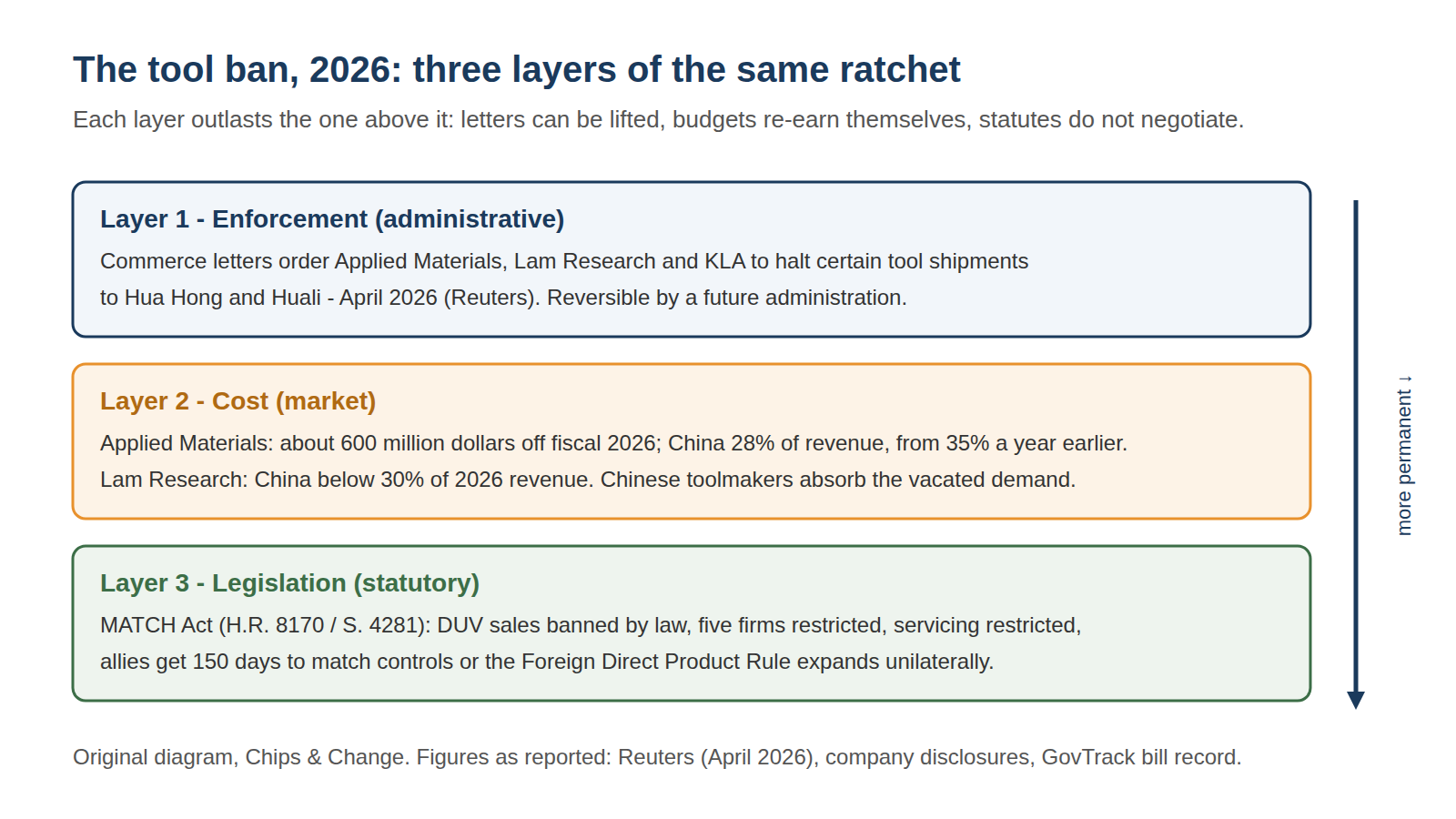
Start with the enforcement layer. In April 2026, Reuters reported that the Commerce Department ordered multiple chip equipment companies, including Applied Materials, Lam Research and KLA, to halt certain tool shipments to Hua Hong, China’s second-largest foundry, and to Huali, with the letters targeting facilities Washington believes may be involved in making the country’s most advanced chips. Hua Hong is not a name-brand AI chip house; it is a mature-node foundry. The message was that the tool ban now reaches beyond the leading edge.
Then the cost layer. Applied Materials said the restrictions would cut roughly 600 million dollars from its fiscal 2026 revenue, and its China share of revenue fell to 28 percent in the third quarter of fiscal 2026 from 35 percent a year earlier. Lam Research expects China to fall below 30 percent of its revenue in 2026. Chosun’s November 10 reporting on the industry data put it plainly: global semiconductor equipment sales to China are plummeting under the controls, while South Korea and Taiwan see AI-driven equipment demand surge. The toolmakers’ order books are fine. Their geographic mix has been redrawn.
The legislative layer is the new one. The MATCH Act, introduced in April 2026 as H.R. 8170 with a Senate companion, would impose countrywide prohibitions on exports of semiconductor manufacturing equipment to China, including DUV lithography systems, designate five Chinese firms as restricted by statute, and give allied governments 150 days to adopt equivalent controls before Washington expands the Foreign Direct Product Rule unilaterally to cover allied-made equipment. It cleared the House Foreign Affairs Committee by a vote of 44 to zero on April 22, 2026, according to the bill’s record as tracked by GovTrack, and has been waiting for a floor vote since. This month, Roll Call reported that congressional committees advanced further bills requiring the Bureau of Industry and Security to work with allied equipment suppliers on coordinated controls and licensing for advanced chips.
Beijing’s side of the ledger is its own set of clocks. China’s one-year suspension of its October 2025 rare-earth export controls expired on November 10, 2026, and as Tech Times reported this week, Beijing has published no legal extension, even as both governments describe the broader trade truce as running to January 10, 2027. The materials that go into magnets, batteries and chipmaking consumables sit one notice away from controls again.
The fab floor read: what a tool ban actually does
What does a tool ban actually do inside a fab? It freezes the top of the process recipe. A Chinese fab under the restrictions can keep running the tools it has, but it cannot buy the next generation of deposition, etch, metrology and lithography equipment, so its node progression stalls at whatever its installed base supports. That is the design of the policy, and it is also its weakness: installed tools need service, spare parts, and software updates, which is why servicing restrictions and the MATCH Act’s focus on servicing installed DUV systems matter as much as the sales bans themselves. A tool you cannot service is a tool with a countdown timer.
The second-order effects are already visible. Chinese domestic toolmakers are absorbing the demand the American firms vacated, which is the fastest possible subsidy for Naura, AMEC and their peers: a captive market, at scale, with a decade to close the gap. And the cap on Chinese capacity is one of the forces propping up the memory and mature-node pricing described on this site Tuesday, because CXMT’s ten-fab expansion plans collide directly with license requirements for advanced equipment. The export controls are doing double duty as industrial policy for everyone outside China.
For the toolmakers, the arithmetic is uncomfortable but survivable while AI demand runs this hot; China revenue is being replaced by Korean and Taiwanese capacity spending, at better margins and lower policy risk. The real exposure is structural: if the MATCH Act passes and the FDPR expands to allied equipment, the industry’s export regime moves from case-by-case licensing to statute, and statutes are much harder to unwind in a thaw. The engineers who lived through the last decade of export controls learned that licenses were policy. The next decade’s lesson may be that policy, once written into law, stops negotiating.
FAQ
What is the tool ban? The set of US export controls restricting sales of advanced semiconductor manufacturing equipment to China. It operates through Commerce Department rules and license requirements, and in April 2026 Commerce ordered equipment makers including Applied Materials, Lam Research and KLA to halt certain shipments to the Chinese foundry Hua Hong.
What is the MATCH Act? The Multilateral Alignment of Technology Controls on Hardware Act, H.R. 8170 and S. 4281, introduced in April 2026. It would write equipment export bans into law, ban DUV lithography sales to China, restrict servicing of installed systems at five named Chinese firms, and give allies 150 days to adopt equivalent controls or face unilateral US expansion of the Foreign Direct Product Rule. It cleared House Foreign Affairs Committee unanimously in April 2026 and awaits a floor vote.
How much revenue are equipment makers losing from the controls? Applied Materials said the restrictions would reduce its fiscal 2026 revenue by roughly 600 million dollars, with China falling to 28 percent of revenue in its fiscal third quarter from 35 percent a year earlier. Lam Research expects China below 30 percent of revenue in 2026.
How does this affect Chinese chipmakers like CXMT? Directly: CXMT’s expansion depends on buying advanced deposition, etch and metrology tools, and those purchases require licenses under the controls. The gap between CXMT’s fab construction plans and the equipment it can legally obtain is one of the main uncertainties in DRAM supply forecasts.