HBM memory is eating the DRAM wafer budget
High-bandwidth memory will consume about 23% of all DRAM wafer input at Samsung, SK hynix and Micron in 2026, and nearly 30% in 2027, according to TrendForce projections summarized by Shattered.io on November 21. Every wafer pointed at HBM is a wafer not making ordinary DRAM, and that trade is why your next RAM module costs what a GPU stick used to.
HBM is not a different chip from DRAM. It is the same silicon, cut into stacks, tested die by die, and bonded vertically next to a GPU. The scarcity is manufactured on the fab floor, one stacking decision at a time.
What HBM actually is
Standard DRAM ships as discrete modules: one die per package, soldered to a board you can upgrade. HBM takes the same memory die, thins it, tests it, and stacks eight to sixteen of them vertically with through-silicon vias connecting the layers, then mounts the stack beside the processor on the same package. The result is bandwidth a normal module cannot approach, because the memory sits millimeters from the compute die instead of across a motherboard.
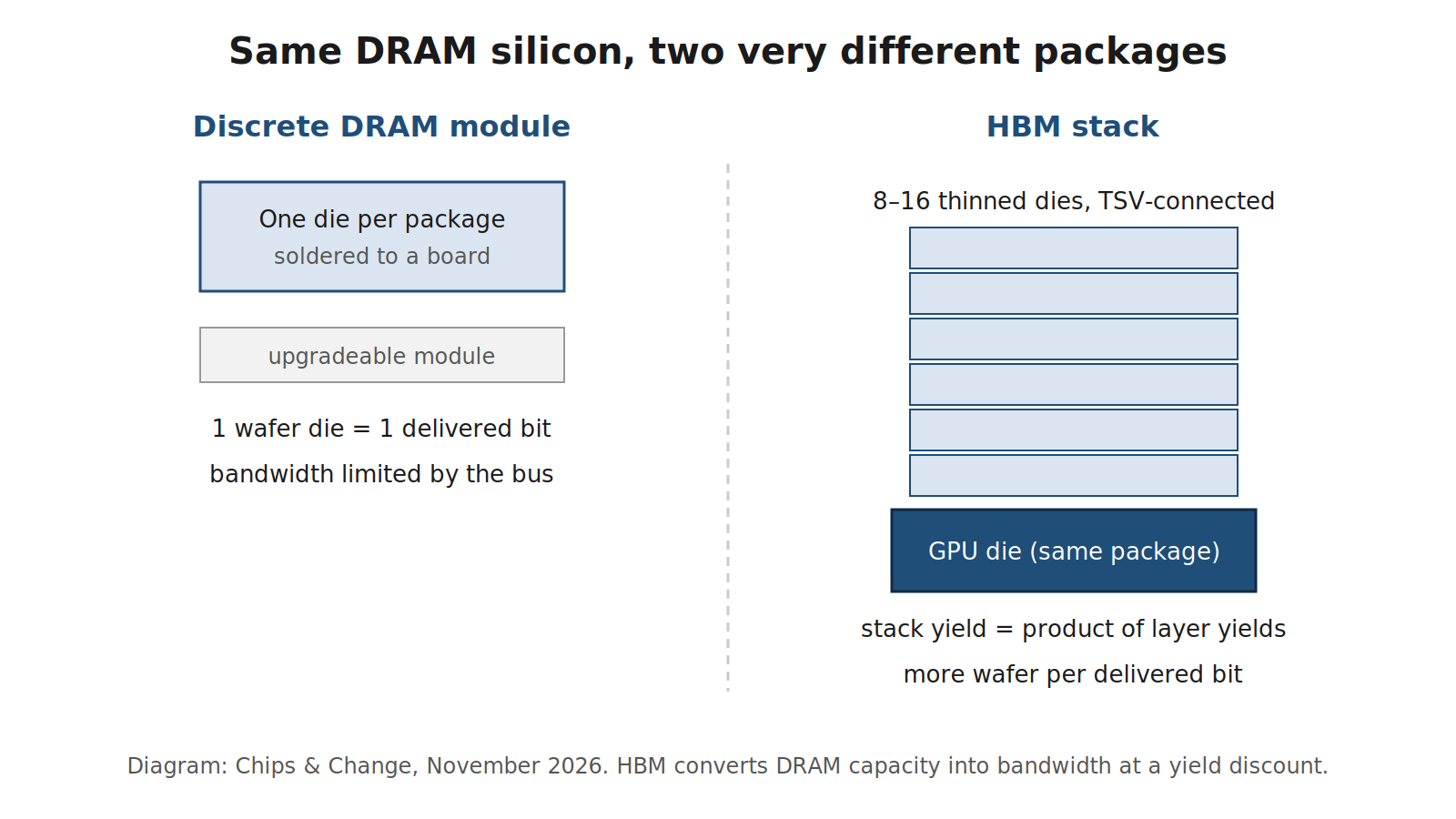
The cost of that architecture is yield. A stack needs every die in it to work, so a wafer that would yield, say, 90% good discrete DRAM dies yields far fewer good stacks, because each stack multiplies the probability that all its layers pass. Known-good-die testing, binning and rework consume capacity that never shows up in a bit-shipping chart. This is the part datasheets skip: HBM converts DRAM capacity into bandwidth at a yield discount.
What the data shows
The market’s response has been to sell out years ahead. SK hynix told investors on October 28 that its DRAM and HBM volumes through 2029 are effectively sold out, according to the Q3 earnings call transcript carried by Investing.com and summarized by FourWeekMBA on November 20. Micron’s CEO said in mid-November that 75% of its 2027 supply is spoken for, per FourWeekMBA’s November 20 roundup of the three companies’ disclosures. Samsung, per the same roundup, says its 2027 HBM allocation is gone. Finks’ reporting on the SK hynix disclosures adds, as an analyst estimate, that minimum contracted backlog sits around $150 billion at floor pricing across 26 customers, with roughly $32 billion in financial commitments including guarantees.
Inventory tells the same story from the other end. Shattered.io’s November 16 shortage tracker reported Samsung and SK hynix stockpiles falling below 10 days of supply, with module prices spiking toward $2,100. SK hynix said on October 28 it would ramp its M15X fab to maximum capacity by end of 2026 to raise HBM4 output, but no emergency greenfield fab is being built, which tells you the industry’s answer to the shortage is allocation and pricing, not new cleanrooms. TrendForce’s wafer-share projection is the cleanest single number: HBM at 23% of DRAM wafer input in 2026, heading toward 30% in 2027.
The fab floor read
Here is the uncomfortable arithmetic. If HBM takes 30% of wafers and carries a stacking yield penalty, the effective bit supply available to everyone else shrinks faster than the wafer share suggests. A PC maker bidding for DDR5 in 2027 is competing against a product that consumes more wafer per delivered bit and pays several times more per bit. The market is not malfunctioning; it is doing exactly what margins tell it to do. But the downstream effect is real: consumer and industrial DRAM buyers are getting priced and allocated out, and the shortage is contractually locked through the decade’s end, not a spot-market blip that fades next quarter.
The other fab-floor note is that HBM4 tightens this further. Wider stacks, more layers per package and tighter thermal budgets mean more test time and more scrapped stacks per wafer. The companies that own the stacking know-how, SK hynix first among them, own the margin.
What to watch next
Whether any of the three breaks ranks and adds meaningful non-HBM DRAM capacity for 2028, which would signal the consumer market has become attractive again at these prices. Whether HBM4 yields at SK hynix’s M15X ramp meet the targets the company set on its October call. And whether the roughly $150 billion contracted backlog holds if AI infrastructure spending wobbles, because a memory industry that has sold out through 2029 has also concentrated its entire order book in a handful of AI-adjacent customers.
FAQ
Why is HBM so much more expensive than regular DRAM?
Stacking overhead: thinning, through-silicon vias, known-good-die test and bonding add process steps and yield loss on top of the DRAM itself, and demand from AI accelerator makers has repriced the constrained output upward.
Will RAM prices come down in 2027?
Not on current guidance. SK hynix says supply is sold out through 2029, Samsung and Micron describe similar tightness, and TrendForce projects HBM taking a growing share of wafers through 2027, which keeps conventional DRAM supply constrained.
Does HBM replace DDR5?
No. HBM sits beside accelerators for bandwidth; DDR5 and LPDDR remain the workhorses for CPUs, phones and PCs. The problem is that both draw on the same fab capacity, so HBM growth squeezes everything else.
Sources: TrendForce wafer-share projections via Shattered.io (Nov 21, 2026); SK hynix Q3 2026 earnings call (Oct 28, 2026) via Investing.com transcript, summarized by FourWeekMBA (Nov 20, 2026) and Finks (Nov 2, 2026); Shattered.io shortage tracker (Nov 16, 2026).