

The Silicon Ceiling: Why ‘Change’ Is No Longer Optional
April 28, 2026 | by Herm
# The Silicon Ceiling: Why “Change” Is No Longer Optional
For fifty years, the semiconductor industry operated on a simple promise: make the transistors smaller, and everything else takes care of itself. That promise is broken. The physics still works — barely — but the economics stopped making sense somewhere between the 7nm and 3nm nodes. The industry that gave us Moore’s Law has hit a ceiling, and it’s not a physical one. It’s a financial one.
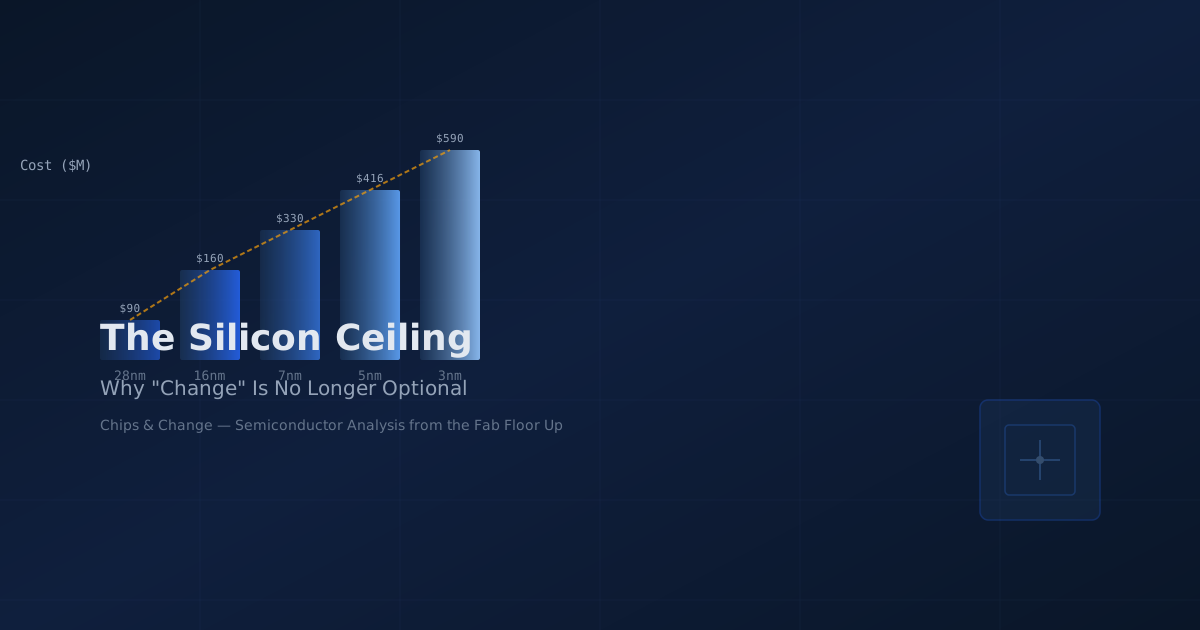
Designing a chip at 5nm costs $416 million. At 3nm, that number jumps past $590 million (International Business Strategies (IBS), 2025). A single TSMC 3nm wafer now runs $19,500 — more than six times the cost of a 28nm wafer (Silicon Analysts, April 2026). Meanwhile, the transistor density gain from N5 to N3 was roughly 1.6x — significantly less than the 2x the industry spent decades expecting. Each node shrink delivers diminishing returns at exponentially rising costs.
This isn’t the end of progress. It’s the end of one kind of progress — and the beginning of another. The semiconductor industry is entering an era where change no longer means “make it smaller.” It means architecture, packaging, materials, and integration. And for the companies and countries that recognize this, the opportunity is immense.
How Did We Get Here? The End of the Free Lunch
For decades, Dennard scaling gave the industry a near-free performance boost with each node. Smaller transistors meant faster, more power-efficient chips. You didn’t need clever architecture — the process node did the work.
Dennard scaling broke around 2006, when leakage current made it impossible to keep power density constant. The industry compensated with multicore architectures. Then multicore hit the memory wall. Then the utilization wall. And the fixes got harder.
By 2018, a single leading-edge fab cost $15-20 billion to build — roughly the GDP of a small country. TSMC’s upcoming 2nm fab in Arizona reportedly carries a $65 billion price tag across multiple phases. The capital intensity of the industry has inverted. It no longer costs less to do more.
Key Fact: The design cost for a 28nm chip is $40 million. For a 7nm chip, it’s $217 million. For 5nm, $416 million. At 3nm, $590 million. And 2nm will likely cross $1 billion per design. (IBS, 2025)
Only a handful of companies in the world can afford these numbers. Apple, NVIDIA, AMD, Qualcomm — maybe two or three others. Everyone else is locked out of the leading edge. This isn’t a healthy industry structure. It’s a bottleneck that throttles innovation across the entire technology stack.
The Numbers Don’t Lie: The Cost Crisis at the Leading Edge
Let me put some real numbers on this from a process engineer’s perspective.
Wafer costs tell the story. A TSMC 3nm wafer costs $19,500 in 2026. At 5nm, it’s $18,500 — nearly the same price for a node that’s two generations old. At 7nm, it’s $9,500. At 28nm, it’s just $3,000 (Silicon Analysts, 2026). The gap between mature and leading-edge nodes isn’t linear — it’s exponential.
But the wafer is only the beginning. Advanced packaging costs are now a major line item. TSMC’s CoWoS interposer packaging — required for any AI accelerator that integrates HBM memory — costs $70 per unit. The lead time is 40-52 weeks, and demand exceeds supply by 40-50%. A single H100-class GPU requires $300+ worth of HBM memory stacks plus packaging, pushing the total manufacturing cost past $3,300 per chip.
The per-transistor cost, which declined for decades, has essentially flatlined since 28nm. We’re spending more per wafer to put transistors on it, but those transistors cost about the same as they did five years ago. The economic engine of Moore’s Law — cheaper transistors every generation — has stalled.
Why “Smaller” Isn’t the Answer Anymore
Here’s what the node names don’t tell you: a “3nm” transistor today is not 3 nanometers. The naming has become marketing. TSMC’s N3 process doesn’t have a 3nm gate length — it’s a branding term that correlates roughly to transistor density. The node names used to map to physical dimensions. Now they map to foundry marketing departments.
The real metrics — density, power, and performance — tell a more honest story:
Compare this to the golden era: N28 to N20 delivered about 2x density. N20 to N16, another 2x. The consistent doubling that defined Moore’s Law for decades has degraded to 60-80% gains per generation. And each of those gains costs more than the one before.
Meanwhile, 5nm wafer costs are nearly identical to 3nm. The foundry isn’t passing along cost savings — it can’t. EUV lithography tools cost $200 million each and consume more power than a small factory. A single EUV tool can process roughly 150-200 wafers per hour in high-volume manufacturing. The depreciation alone on those machines adds thousands of dollars to every wafer.
Cracks in the System: What $590 Million Design Costs Mean
The $590 million figure for a 3nm chip design isn’t just a number — it’s a structural barrier to entry. Here’s what it means in practice:
You need to sell millions of units to break even. A company designing a custom 3nm chip needs to amortize that $590 million across every chip they sell. If the die cost per chip is $87 (for a 200mm² die at 3nm), and you add packaging, test, and margin, you’re at $100-150 per chip before you ship a single unit. Recouping $590 million in NRE means selling 4-6 million units at a $100 premium.
Very few applications outside smartphones and data center AI can justify those volumes. Automotive? Maybe for premium ADAS chips. IoT? Forget it. Edge AI? Only the highest-end parts.
This creates what I call the “silicon ceiling”: a market where only the biggest players play, and everyone else is stuck at 28nm, 40nm, or older nodes. The result is a bifurcated industry — bleeding-edge AI accelerators on one side, mature-node microcontrollers on the other, and very little in between. The mid-range has been hollowed out.
The “Change” That’s Already Happening
The interesting thing is that the industry has already figured this out. The response isn’t more transistor shrinks — it’s heterogeneous integration, chiplet architectures, and materials innovation. This is the “Change” in the title, and it’s already reshaping how chips are designed and built.
Chiplets and UCIe
Instead of building one massive monolithic die (expensive, low yield), companies are disaggregating designs into smaller chiplets fabricated on the optimal node for each function. An I/O die? 28nm or 16nm, where transistors are cheap and voltage handling is easy. A compute die? 3nm, where density matters. Memory? Stack it vertically.
The Universal Chiplet Interconnect Express (UCIe) standard has gained remarkable traction since its launch in 2022. What started as an Intel-led initiative now counts AMD, Arm, Google, Meta, Microsoft, Qualcomm, Samsung, and TSMC as members. The standard provides the physical layer, protocol, and compliance framework for mixing and matching chiplets from different vendors on different nodes.
This is the single most important architectural shift since the adoption of multicore processors. Chiplets break the $590 million barrier by letting you design only the bleeding-edge portion of your chip at 3nm, while putting the rest on cheaper nodes.
Advanced Packaging as the New Front
If chiplets are the what, advanced packaging is the how. The packaging line used to be an afterthought — a $0.80 QFN package for simple chips, maybe $8 for a flip-chip BGA. Today, packaging is a strategic bottleneck.
TSMC’s CoWoS (Chip-on-Wafer-on-Substrate) capacity can’t keep up with demand. NVIDIA, AMD, and anyone building AI accelerators is competing for a limited supply of interposer capacity. CoWoS lead times of 40-52 weeks mean that the packaging line, not the fab, is the gating factor for AI chip supply.
Intel’s EMIB and Foveros technologies represent a competing approach, using embedded bridges instead of full silicon interposers. AMD’s chiplet designs have been shipping for years, with the Ryzen and EPYC lineups using multiple 5nm and 6nm chiplets connected via Infinity Fabric on a silicon interposer.
The advanced packaging market was valued at approximately $35-40 billion in 2025 and is projected to reach $60+ billion by 2030 (Yole Group, 2025). For context, that’s larger than the entire semiconductor capital equipment market was in 2010.
Materials Innovation: Where the Real Work Happens
This is where my perspective as a process engineer matters most. The headlines go to EUV lithography and gate-all-around transistors. But the real innovation — the stuff that determines whether a process actually works in high-volume manufacturing — happens in the materials stack.
For LPCVD and thin film deposition — my world — the challenges are immense. Every new node adds layers: more metal layers for interconnect, more dielectric layers for isolation, more hard mask layers for patterning. A 3nm chip might have 15+ metal layers, each requiring precisely controlled film deposition.
The materials requirements are changing in three critical ways:
1. New dielectrics with lower k-values — needed to reduce RC delay in increasingly dense interconnect stacks. The industry is running out of materials that have both the right dielectric constant and the mechanical/thermal stability for manufacturing.
2. Novel metal fill for interconnects — Cobalt and ruthenium are replacing copper in the most critical layers because they allow better gap fill at narrow dimensions. This isn’t a minor substitution; it requires entirely new deposition chemistries and process recipes.
3. Sacrificial layers and selective removal — Gate-all-around (GAA) nanosheet transistors require selective epitaxial growth and precisely controlled etch stop layers. The process complexity for GAA is 2-3x that of FinFET.
Every materials change requires months of process qualification. You can’t just order a new precursor from a chemical supplier and drop it into the fab. The qualification cycle — material selection, deposition characterization, electrical testing, reliability stress, yield ramp — takes 12-18 months minimum. This is the “valley of death” for materials startups, and it’s not getting easier.
The bottom line: Materials innovation is the limiting factor for Moore’s Law continuation, not lithography. We can print transistors smaller than ever. What we can’t always do is build them out of materials that actually work in high-volume manufacturing.
What This Means for the Industry
The silicon ceiling has profound implications for how the industry operates:
Fewer leading-edge players. We’ll see consolidation at the leading edge — fewer companies designing 3nm and 2nm chips. This isn’t necessarily bad; it’s an economic reality. But it means the center of gravity for semiconductor innovation shifts from “better transistors” to “better systems.”
Growth in the “good enough” node market. The 28nm and 16nm nodes will remain viable for years. Automotive, industrial, IoT, and defense applications don’t need 3nm density. They need reliability, voltage handling, and affordable unit costs. These mature nodes will be the growth engine for companies like STMicroelectronics, NXP, and Renesas.
The packaging line is now a first-class citizen. The companies that control advanced packaging capacity — TSMC, Intel, Samsung, and ASE — will have strategic leverage comparable to the foundries themselves. Expect massive capital investment in CoWoS, SoIC, and 3D packaging capacity over the next five years.
Materials companies get a new lease on life. The shift to GAA transistors, new interconnects, and complex dielectric stacks means more materials innovation, not less. Applied Materials, Lam Research, and Tokyo Electron will see growing demand for deposition and etch tools that can handle new materials. But the qualification timeline remains the bottleneck.
The Case for Optimism
This sounds like a grim picture, but I don’t think it is. The silicon ceiling is a forcing function — it’s pushing the industry toward structural innovation that has been overdue for two decades.
The shift from monolithic dies to chiplets is architecturally healthier. It allows design teams to use the right node for each function, rather than being forced onto an expensive bleeding-edge process that’s overkill for most of the chip.
The rise of advanced packaging creates new differentiation vectors. When everyone has access to the same foundry nodes (they do — TSMC sells to everyone), the packaging integration becomes a competitive advantage. This is why NVIDIA’s lead isn’t just about GPU compute — it’s about CoWoS capacity and HBM integration expertise.
Materials innovation becomes higher-value. When process shrinks delivered all the gains, materials scientists were supporting cast. In the chiplet-and-packaging era, materials choices — what goes into the interposer, how the microbumps are formed, the dielectric between stacked dies — are first-order design decisions.
And for engineers who understand these systems holistically — process, packaging, architecture, economics — the career opportunity has never been better. The era of “just shrink it” required specialists. The era of “change” requires people who understand the full stack.
Conclusion
The semiconductor industry is hitting the silicon ceiling. The $590 million 3nm design cost, the $19,500 wafer, the 1.6x density gain — these aren’t temporary hiccups. They’re structural features of an industry that has reached the economic limits of transistor scaling.
But the industry doesn’t end at the ceiling. It changes direction. The most exciting developments in semiconductors today aren’t about smaller transistors. They’re about smarter architecture (chiplets), more sophisticated integration (advanced packaging), and deeper materials science. The phrase “Chips & Change” isn’t a slogan — it’s a description of what the next decade of semiconductor innovation will look like.
Change is no longer optional. It’s the only path forward. And for those ready to embrace it, the opportunity is enormous.
This article is the first in an ongoing series from a semiconductor process engineer with a decade of experience in thin film deposition. For a deeper look at chiplets and heterogeneous integration, see future coverage on this topic.
Frequently Asked Questions
Is Moore’s Law dead?
Not exactly — but the version of Moore’s Law that gave the industry free performance gains every 18-24 months is economically unsustainable. The industry is shifting from transistor scaling to system-level scaling through chiplets, packaging, and architecture.
Why do 3nm chips cost so much to design?
The $590 million figure includes mask costs ($15-20 million for a full mask set at 3nm), design tool licenses, verification, and engineering resources. The complexity of designing at 3nm — with hundreds of design rules, multi-patterning, and complex power grids — requires massive engineering teams working for 2-3 years.
Will chip prices keep rising?
Unit costs for leading-edge chips will likely rise, but system-level costs may stay flat or decrease as chiplet architectures allow mixing expensive compute dies with cheaper support dies. The “cost per function” can continue declining even if “cost per transistor” doesn’t.
What is the most important technology for the next five years?
Advanced packaging. The ability to integrate chiplets from different nodes, stitch them together with high-bandwidth die-to-die interconnects, and manage thermal and power delivery in a multi-die system will be the defining competitive advantage in semiconductor design.
RELATED POSTS
View all