

The ‘Old’ Chip Crisis: Why 28 nm Still Rules the World
May 12, 2026 | by Herm
# The “Old” Chip Crisis: Why 28 nm Still Rules the World
Every headline about the semiconductor industry focuses on the bleeding edge — 3nm, 2nm, gate-all-around transistors, and AI accelerators. But the chips that actually run the world are made on nodes that are a decade old. The automotive in your car, the microcontroller in your medical device, the power management IC in your phone charger, the RF chip in your 5G base station — most of these are built on 28nm, 40nm, 65nm, or even 180nm processes.
And here’s the uncomfortable truth: demand for these “old” nodes is exploding faster than supply can keep up.
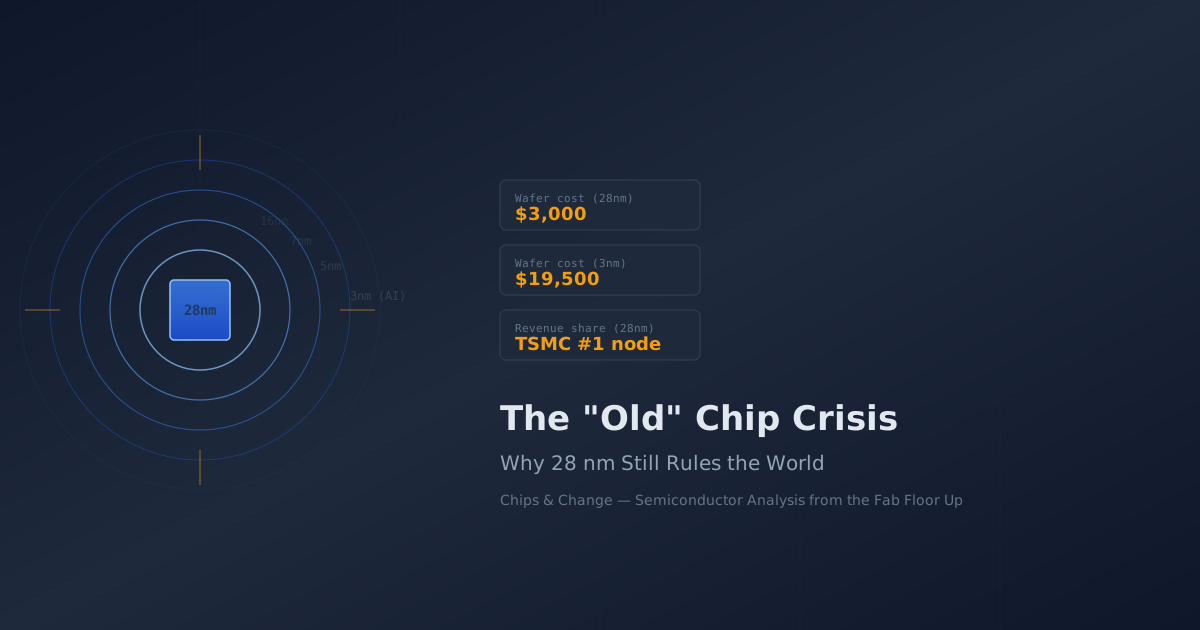
A TSMC 28nm wafer costs $3,000 — roughly one-sixth the price of a 3nm wafer (Silicon Analysts, 2026). But the more important number is this: the 28nm node generated more revenue for TSMC in 2024 than any of its older nodes, and demand hasn’t stopped climbing. Automotive electrification, IoT proliferation, industrial automation, and the buildout of 5G infrastructure are all driving a surge in mature-node demand that the industry’s foundry capacity wasn’t built to handle.
The Node That Won’t Die
The 28nm node entered production in 2011. It has now been in high-volume manufacturing for fifteen years — an eternity in an industry where the leading edge advances every 2-3 years. By the standards of silicon technology, 28nm should be ancient history.
Instead, it’s more important than ever.
Why 28nm has staying power:
1. Cost. At $3,000 per wafer, 28nm is affordable for a massive range of applications. A simple IoT microcontroller on 28nm might cost $1-2. The same die on 3nm would cost 6-10x more for no real benefit, since the application doesn’t need the density or performance.
2. Analog performance. Transistors at 28nm still have good analog characteristics — high breakdown voltage, low flicker noise, good matching. As you shrink below 28nm, analog performance degrades significantly. This is why mixed-signal chips, power management ICs, and RF circuits tend to stay on mature nodes. A 3nm transistor switches faster, but it can’t handle 5V signals or drive high currents.
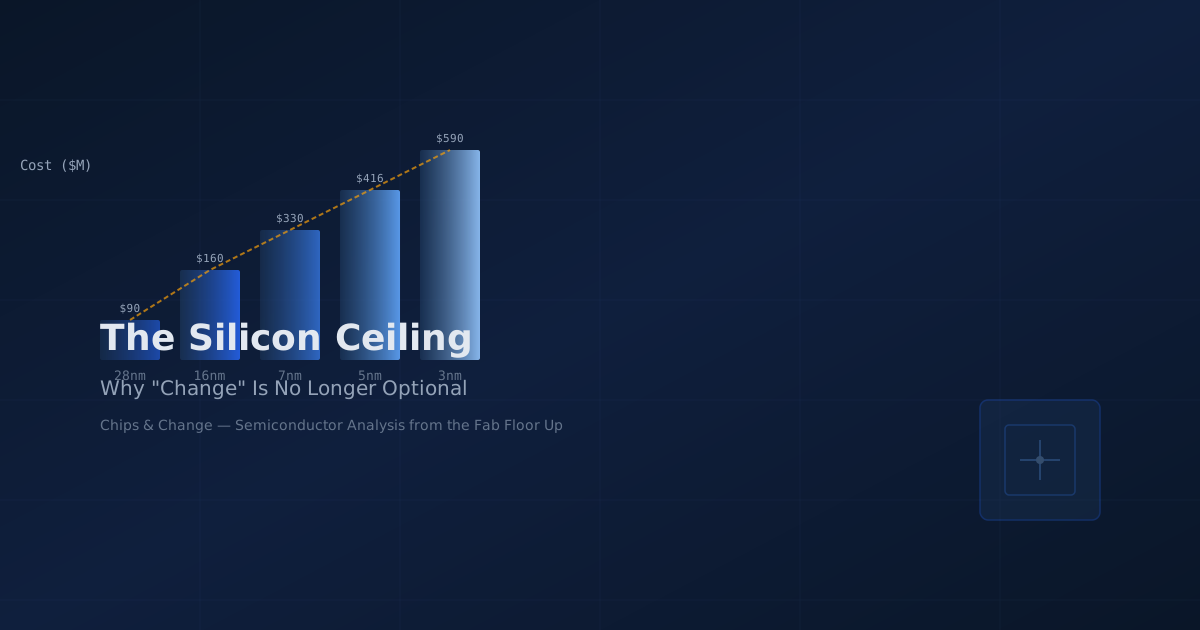
3. Design cost. As noted in our first article, designing a 28nm chip costs approximately $40 million versus $590 million at 3nm (IBS, 2025). For a company designing an automotive microcontroller that will sell for $15, those economics are decisive. You can’t amortize $590 million over a chip that makes $3 in profit per unit.
4. Reliability. Mature nodes are incredibly well-characterized. 28nm has been qualified across hundreds of millions of device-hours. Automotive-grade 28nm processes meet AEC-Q100 requirements and support operating temperatures up to 150°C. Defense-grade processes meet MIL-STD requirements. The reliability data is thousands of pages thick. A new node would need 5-10 years to achieve similar qualification coverage.
5. Established supply chain. The equipment set for 28nm is fully depreciated and well-understood. Fab engineers know every failure mode. The supply chain for materials, spares, and chemicals is optimized. When you’re running a 28nm fab, you’re not solving new problems — you’re optimizing throughput.
Key fact: 28nm (and its derivative 22nm) is expected to account for approximately 15-20% of TSMC’s revenue through 2027 and beyond. The node has been in production for 15 years and shows no signs of decline. (TrendForce, 2025)
The Capacity Crunch Nobody Talks About
The 2021-2023 semiconductor shortage was widely covered as an automotive chip crisis. What was less understood: the crisis was almost entirely a mature-node crisis. The chips in short supply — microcontrollers, power management ICs, display drivers, sensors — were all on 28nm to 180nm processes. The leading-edge AI chips that hogged the headlines were actually in ample supply.
The issue was capacity allocation. During the pandemic, automakers canceled chip orders, then tried to reinstate them when demand came roaring back. Foundries had reallocated that capacity to consumer electronics and other applications. And here’s the structural problem: you can’t quickly add mature-node capacity.
Building a new 28nm fab costs $5-10 billion and takes 2-3 years. But more importantly, the equipment for 28nm is no longer in high-volume production. The lithography tools, deposition chambers, and etch systems that TSMC’s 28nm fabs use are based on older designs that ASML, Applied Materials, and Lam Research stopped manufacturing years ago. You can’t just order a new 300mm 28nm production line from a catalog. You’d need to source used equipment, commission it, and qualify it — a process that takes 12-18 months even with experienced teams.
The result is a structural supply constraint. Global mature-node capacity (28nm and larger) is estimated at approximately 6-7 million wafer starts per month across all foundries. Demand is estimated at 7-8 million wafer starts per month and growing. The gap of 15-20% creates persistent shortages in automotive, industrial, and medical chips.
Who Cares About 28nm? Everyone.
Let me be specific about which industries are most affected by the mature-node crunch:
Automotive is the biggest driver. A modern mid-range car contains 1,000-1,500 chips. Of those, maybe 10-20 are on advanced nodes (the infotainment SoC, the ADAS processor). The rest — powertrain controllers, body control modules, sensor interfaces, battery management ICs — are on 28nm to 180nm. The transition to electric vehicles actually increases the demand for mature-node chips, because EVs have more power management ICs, more sensor interfaces, and more motor controllers than ICE vehicles.
Industrial automation and IoT are rapidly growing markets. An industrial sensor that runs for 5 years on a coin cell battery needs an ultra-low-power microcontroller, not a 3nm GPU. The LoRaWAN modem, the temperature sensor signal chain, the wireless MCU — all on mature nodes.
Medical devices are almost entirely on mature nodes. A pacemaker, a hearing aid, a continuous glucose monitor, a defibrillator — none of these need leading-edge compute. They need ultra-low power consumption, high reliability, and small die area (but not microscopic transistors). Medical device qualification cycles are 3-5 years minimum, so once a design is locked to a node, it stays there.
Defense and aerospace use mature nodes almost exclusively, for reliability reasons. The F-35’s electronic warfare system runs on 65nm and 45nm chips. Military-grade process qualification takes years, and the volumes are too low to justify leading-edge economics.
The Economic Reality
Here’s the tension that policymakers and investors don’t fully appreciate: the profit margins on mature-node chips are thinner, but the volumes are larger.
A 3nm AI accelerator might sell for $15,000-30,000 (an NVIDIA H100-class part) with gross margins of 70-80%. But the total addressable market is maybe 10 million units per year across all vendors. A 28nm automotive microcontroller sells for $5-20 with gross margins of 40-50%. But the market is billions of units per year. The revenue opportunity in mature nodes, in aggregate, may actually be larger than the leading edge.
This is why the CHIPS Act’s focus on leading-edge fabs — while strategically essential — may miss a key economic reality. The US and its allies don’t just need 3nm and 2nm fabs. They need 28nm, 40nm, and 65nm capacity. The current funding and incentives overwhelmingly favor leading-edge construction, but the supply bottleneck is at the mature end of the spectrum.
An underappreciated risk: If mature-node capacity doesn’t expand, we’ll see recurring shortages in automotive and industrial chips — not because of another pandemic, but because demand structurally outpaces supply. The “everything shortage” of 2021-2023 wasn’t a one-off. It was a preview of the mature-node supply-demand imbalance that will persist through 2030.
The Rise of the Specialty Foundries
The mature-node market isn’t all TSMC. In fact, the landscape is more diverse than at the leading edge:
- UMC (Taiwan) — Strong position in 28nm and 22nm, capacity expansion ongoing
- GlobalFoundries (US) — Focused on 12nm-180nm for automotive, defense, and IoT. Public offerings have funded capacity expansion
- SMIC (China) — Strong in 28nm-180nm for the domestic Chinese market. Under export restrictions for leading-edge tools
- STMicroelectronics (Europe) — IDM with strong mature-node position in automotive and industrial
- Texas Instruments (US) — Major investment in 300mm mature-node capacity in Texas and Utah
- Renesas, NXP, Infineon — IDMs with captive mature-node fabs for automotive
These specialty foundries and IDMs are investing billions in new capacity. GlobalFoundries is spending $4 billion to expand its Singapore and New York fabs. TI’s $30 billion investment in new 300mm fabs in Sherman, Texas is one of the largest single corporate investments in US manufacturing history — and it’s entirely for mature-node analog chips, not leading-edge digital.
Key fact: Texas Instruments is investing $30 billion in new 300mm mature-node fabs in Sherman, Texas, focused on 28nm to 130nm analog and embedded processing chips. This is the largest single manufacturing investment focused entirely on mature nodes. (TI Investor Relations, 2024-2025)
Can New Nodes Compete with 28nm?
One counterargument: won’t the industry just migrate mature-node designs to newer, cheaper nodes over time? The answer is: not really, for a few reasons.
28nm was the last planar node. At 28nm, transistors are still planar (laid flat on the silicon surface). Below 28nm, FinFET transistors (where the channel sticks up like a fin) become necessary for performance and leakage control. FinFETs are fundamentally different devices — different electrical characteristics, different design rules, different modeling. Migrating a 28nm design to 16nm FinFET requires a complete redesign, not a simple shrink.
The “sweet spot” for cost is at 28nm. Even though 16nm wafers are denser, the per-wafer cost is significantly higher. For chips with moderate die area and high voltage requirements, 28nm often has the lowest total system cost.
28nm has better off-state leakage. For battery-powered applications that spend most of their time in sleep mode, 28nm’s transistor characteristics are often superior to FinFET nodes. A 28nm microcontroller can draw nanowatts in sleep mode; a 16nm FinFET version might draw microamps. For a medical implant that needs to last 10 years, that difference is decisive.
What This Means for the Industry
The mature-node crunch has implications across the semiconductor value chain:
For chip designers: Expect longer lead times and higher costs for 28nm tapeouts. Foundries are increasingly selective about which mature-node designs they accept, prioritizing high-volume, long-lifecycle applications (automotive, industrial) over lower-volume consumer designs. Designers should plan for 40-52 week lead times on mature-node wafers.
For equipment companies: The market for used 300mm equipment has never been stronger. Companies that can refurbish and qualify older lithography, deposition, and etch tools for 28nm production have a significant market opportunity. Applied Materials and Lam Research have launched new programs to support “extended-life” mature-node equipment.
For investors: The traditional semiconductor narrative — “newer is always better” — misses the reality that mature-node capacity is structurally undersupplied. Companies with strong mature-node positions (Texas Instruments, GlobalFoundries, STMicroelectronics) may offer more predictable growth than leading-edge companies with massive capex requirements.
For policymakers: Mature-node capacity should be part of any comprehensive semiconductor strategy. The CHIPS Act’s R&D programs and manufacturing incentives should explicitly support new mature-node fabs, not just leading-edge. A car doesn’t run on 3nm chips — it runs on 28nm, 40nm, and 65nm chips. A secure semiconductor supply chain requires both.
Conclusion
The semiconductor industry has a bias toward the new and the shiny. The media covers the 3nm GPU launch, not the 28nm automotive MCU that ships 50 million units a year. But the chips that run the world aren’t the ones that make headlines. They’re the “old” chips on 28nm, 40nm, and 65nm — built on technologies that are a decade or more old, produced in volumes that dwarf the leading edge, and essential to every modern industry.
The mature-node capacity crunch is the semiconductor industry’s hidden crisis. It doesn’t get the attention of AI or geopolitics, but it affects more industries and more people. And it’s not going away.
The next time someone tells you the most important chip in the world is on 3nm, ask them what the sensor reading that data is running on. The answer is almost certainly 28nm.
This article is part of the Fab Floor Reality pillar of Chips & Change. For the broader economic context, see our article on The Silicon Ceiling: Why ‘Change’ Is No Longer Optional.
Frequently Asked Questions
Why can’t they just make more 28nm chips?
The equipment for 28nm fabs is no longer in volume production. New 300mm fabs for 28nm require sourcing used equipment, which is expensive and time-consuming. Additionally, foundries are prioritizing capital investment in leading-edge fabs where margins are higher.
Is 28nm good enough for AI?
For AI inference at the edge, sometimes — 28nm can run efficient inference for small models. For training or large language model inference, no. But AI training makes up a tiny fraction of the total semiconductor market by volume.
Are newer nodes cheaper per chip?
For very large, dense digital chips, yes. For analog-heavy, mixed-signal, or high-voltage chips, no. The per-transistor cost has flatlined since 28nm, and for many applications the total system cost favors mature nodes.
Will we run out of mature chips again?
Recurring shortages in specific mature-node segments are likely through 2028-2030 as demand growth outpaces capacity additions. The shortages won’t be as acute as 2021-2023 but will create persistent supply constraints in automotive and industrial markets.
RELATED POSTS
View all